

Okay, so check this out—I’ve been poking around Solana tools for years. Wow! The landscape keeps changing. At first glance a blockchain explorer looks simple. But our interactions with on-chain data are messy, fast, and sometimes deceptive, and that matters for tokens you care about. My instinct said: you need clarity, not noise.
Whoa! Seriously? Yes. Token trackers can save you from bad trades. They can also reveal interesting patterns. Medium-level users often miss on-chain context because they rely on market charts alone, which is a mistake. Initially I thought that most token info lived in wallets and exchanges, but then I realized there’s a whole layer of truth on-chain that tells a different story.
Here’s the thing. A good token tracker shows more than price. It shows ownership distribution, recent transfers, mint authority status, and mint supply changes. Those data points are crucial when a new token launches or when a rug-pull risk emerges. I’m biased, but I prefer tools that give raw evidence, not just pretty visuals.
Really? Yep. You can spot whales. You can spot wash trades. You can see if the devs renounced control. And sometimes you see somethin’ weird that charts hide… For example, a sudden spike of small transfers from one address might indicate an airdrop botnet or a laundering pattern, though actually, wait—let me rephrase that—sometimes it’s legitimate market-making activity, so you need to read the context.
For Solana in particular, speed and parallelization change the signal. Transaction throughput is high, so on-chain traces are dense. That makes the role of filters and good UI essential, because without them you get overwhelmed. On one hand, raw data is golden; on the other hand, you don’t want to drown in it. My method is to combine automated filters with a quick human scan.
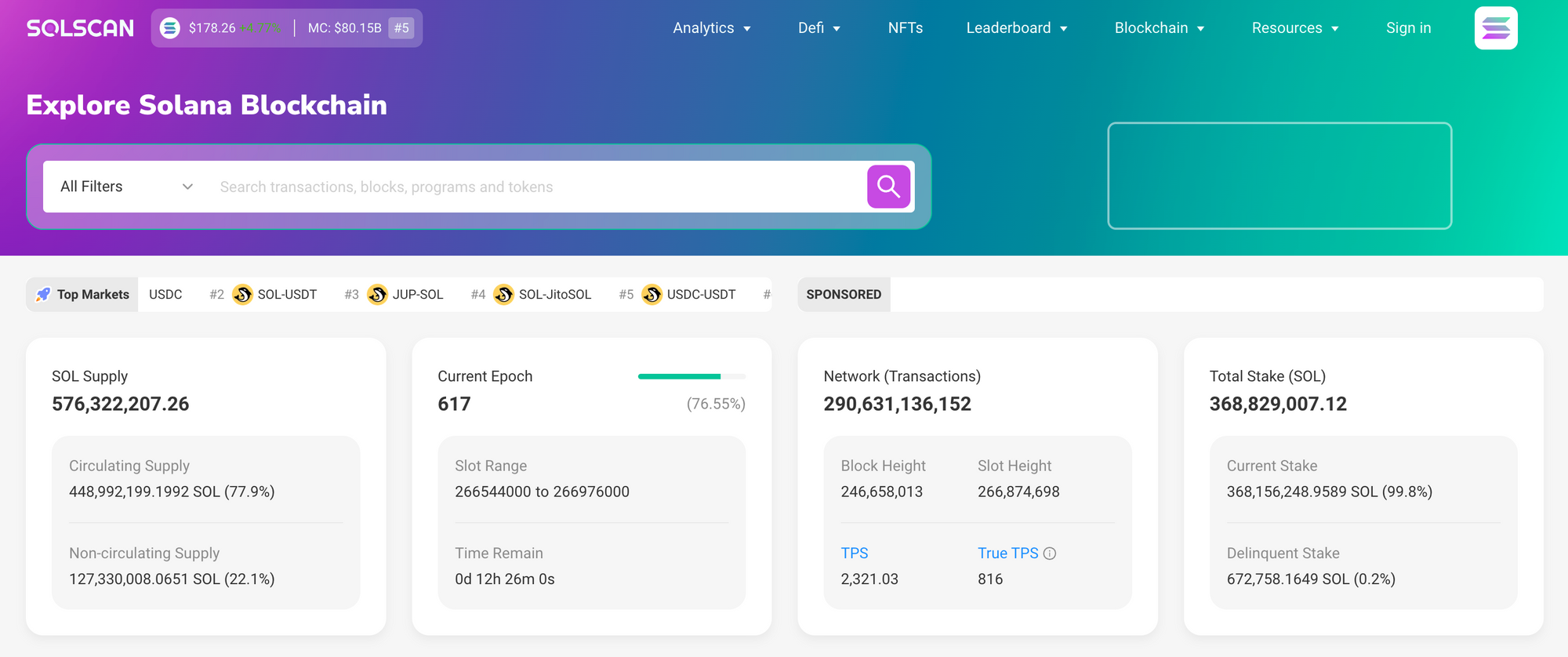
How I use solscan explorer to track tokens and why it works
When I’m tracking a token I open the token page and scan the holders list first. Hmm… it’s a ritual. I look for top holders with >5% concentration. Then I check the recent transactions for spikes or repeated transfers. The solscan explorer interface makes this quick because the holder snapshot and tx timeline are on the same flow, and that saves time.
Short checks first. Then deeper checks. I click through to suspicious addresses and examine their token portfolios. Sometimes the owner is obviously an exchange or a known market maker. Other times the holder is an anonymous wallet that just popped up. That raises a flag. On the contrary, a well-distributed cap table reduces downside, though it doesn’t eliminate risk entirely.
My process has a few repeatable steps. Step one: verify total supply and decimals. Step two: confirm mint authority status. Step three: scan top 20 holders and look at transaction cadence. Step four: search for contract interactions that mint or burn supply. It’s not glamorous, but it’s effective. And sometimes I find something unexpected and it changes the trade decision midstream.
Something felt off about that token last month. I saw frequent micro-mints from one address. Whoa! That triggered me to pause and ask more questions. Initially I thought it was airdrop distribution, but further checks showed coordinated minting that later correlated with sudden sells. On one hand the project claimed transparency; on the other hand the on-chain facts told a different story.
Tools like solscan explorer give you timestamps, signatures, and program logs. Those are the breadcrumbs. You can map transfers to program calls, and that often reveals if a swap program or a custom contract is doing something non-standard. I like being thorough, and yes, sometimes I overdo the forensic digging. But digging pays off.
Okay, pro tips. Use the “token activities” filter to focus only on transfers. Use the API endpoints for batch checks if you automate alerts. Check associated token accounts — they can be many per wallet — and don’t trust token symbols alone. Symbols can be spoofed. Real token identity comes from the mint address and its metadata, and that is where explorers shine because they show on-chain metadata alongside social links.
I’ll be honest—there are limitations. Not all metadata is reliable. Off-chain links in metadata might be dead. Some projects host resources on IPFS or a third-party site that disappears. So practice cross-verification. Check the GitHub, the team’s Twitter footprints, and any trusted audits. This is extra work but it reduces surprise.
Oh, and by the way, watch out for near-duplicate token names. People create tokens with similar names to confuse investors. That’s shady, and it still happens. If a token jumps 1000% overnight but has high supply concentrated in one wallet, that’s a red flag. Conversely, organic growth often shows lots of small holders gradually accumulating over time.
Practical checklist for an on-chain token audit
Quick checklist I use in a rush: 1) Confirm mint address. 2) Check total supply and decimals. 3) Inspect top holders and distribution. 4) Review recent large transfers. 5) Look for mint/burn events. 6) Verify mint authority and freeze authority. 7) Cross-link on-chain metadata to off-chain proofs. Do them in that order. This order keeps me from being misled by price action.
Not everything will be clear. Sometimes the data is ambiguous. Sometimes you need to ask the project team direct questions. And sometimes they don’t answer. That part bugs me. But a reliable explorer reduces ambiguity significantly by delivering transparent, timestamped evidence you can trust.
FAQ
How do I confirm a token is the official one?
Look at the mint address and its on-chain metadata. Verify the token’s social links and GitHub from the metadata, if present, and cross-check those resources. Check large holder identities — if major exchanges or known wallets appear, that suggests legitimacy; however, do not rely on a single sign. Also, inspect the mint authority and whether it’s renounced, because retained authority can enable unexpected minting.
Can I automate alerts on suspicious activity?
Yes. Use explorer APIs or webhooks to monitor large transfers, mint events, or sudden concentration changes. Automate initial filters, then do a manual review when alerts fire. Automation reduces reaction time, though human judgment is still required to interpret nuance.
So where does that leave you? If you’re serious about tokens on Solana, build a short routine and use an explorer that gives you both breadth and depth of data. The data won’t make decisions for you, but it will inform them meaningfully. I’m not 100% sure on everything, but that’s the point—be skeptical, dig in, and use on-chain evidence to tilt the odds in your favor. Somethin’ tells me that kind of diligence pays off in the long run…